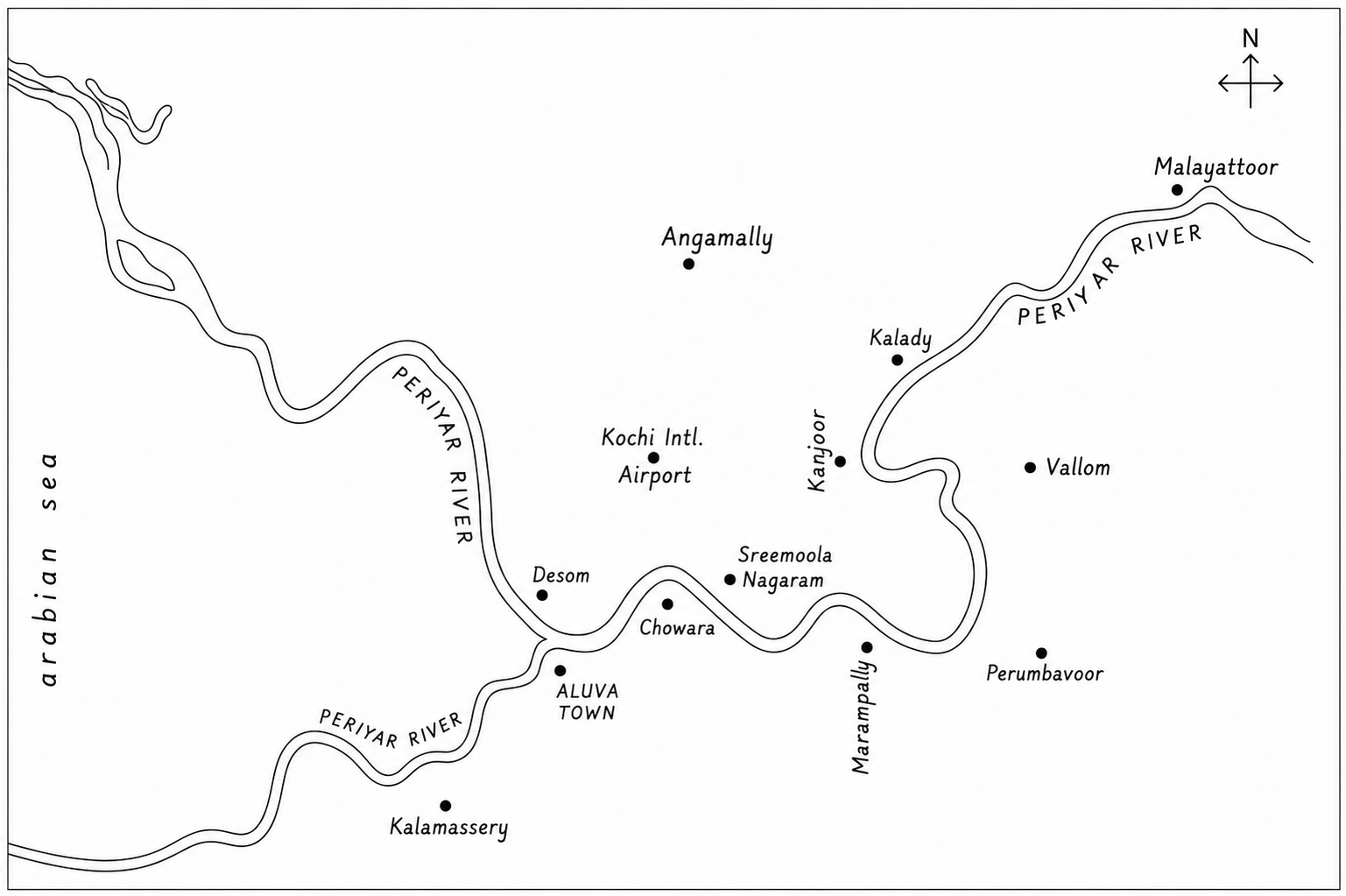
In Sevens, the Periyar River is not merely a river in the area where the story is set; it is very much a character in its own right. The village of Chowara, where the young boys grow up, is situated on its banks, and they spend much of their time close to the river. The novel also touches on the river’s deterioration over a relatively short period of time—a change brought about by development and profiteering, a fate shared by many natural waterways around the world.
The story is set in the region surrounding the Periyar River, on both sides of its banks, encompassing villages such as Chowara and several nearby towns, as shown on the map. Near Chowara, the river forks into smaller branches before eventually merging with the backwaters that connect to the Arabian Sea.
The Periyar is the largest river in the state of Kerala, a region blessed with numerous rivers and water bodies, including its famed backwaters. It has long been the lifeline of the communities through which it flows. People have depended on it in countless ways—from providing water for subsistence farming along its banks to generating the hydroelectric power that helped sustain the heavy industries of the Aluva industrial belt. Overdevelopment and exploitation, however, have diminished some of the river’s natural beauty. This is the same river celebrated in popular Malayalam film songs and immortalized in Malayalam literature as a symbol of grace and abundance.
The Periyar River also carries immense historical significance, and the novel touches on some of that history. Before the formation of the modern state of Kerala, the river marked the boundary between the princely states of Travancore and Kochi. Those states were merged into Kerala long before I was born, yet I still remember seeing the remnants of customs offices on either side of the river near where I grew up.
Tipu Sultan of Mysore, who resisted British rule in India but also invaded neighboring kingdoms, advanced as far as the opposite bank of the river from where I grew up. The region remains rich with legends about that invasion, particularly where written records are scarce. Adi Shankara’s birthplace, Kalady, lies only a few kilometers upstream from the famous Saint Sebastian Church, which is said to have been vandalized during Tipu Sultan’s campaign. Further upstream is Malayattoor, where Saint Thomas the Apostle is believed to have established a church. Regardless of the historical certainty of those traditions, Christianity has flourished in this region since ancient times through its connection to the spice trade. Many of the spices grown in the surrounding hills were transported along the Periyar to the ancient ports on the Arabian Sea, through which both Christianity and Islam reached the areas along the Periyar peacefully through trade, immediately after they were formed in the Middle East.
When I started writing Sevens, the Periyar River was always part of the plan. It flowed into the narrative naturally, much as the river itself swells during the monsoon and spills into the canals, streams, and inlets that branch from its banks.