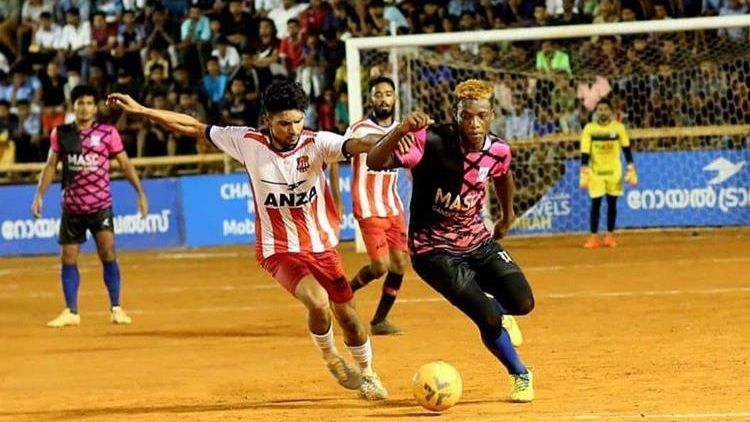
The title of the novel is attributed to two things: the Sevens football culture in Kerala and the core group of seven boys who help form a Sevens football club in their village, whose stories make up a major part of the novel.
Sevens football, known in Kerala simply as Sevens, is a seven-a-side format of soccer. It was born out of local necessity. In Kerala, where large playgrounds are in short supply, football players often have to play the game on whatever small patches of land are available, including makeshift grounds on fallow paddy fields when they are not being cultivated. The number of players is reduced from the standard eleven to seven, and other aspects of the game are adjusted accordingly for dealing with the space crunch. The format is well described in the novel:
The Sevens, or seven-a-side format of football in Kerala, was born out of the necessity of accommodating fewer players on small parcels of maidans and makeshift grounds on fallow rice paddies. Yet the tournaments followed certain guidelines and rules that differed from the standard eleven-a-side format of football. John Mathew provided all the necessary information to Thomas Manjila, who studied it closely and looked at how the rules could be applied at the school playground in Chowara.
A Sevens football team has a total of ten players—seven on the field, as the name suggests, including the goalkeeper, and three reserves, including one substitute goalkeeper. The list of team members has to be provided to the organizers at the beginning of a match and cannot be changed during that match, though teams often change their lineups during a tournament, and organizers usually do not insist on keeping the composition of the team fixed. Sevens football has a simple formation on the field—three defenders, one each on the right, center, and left, and three forwards, one each on the right, center, and left. In the heat of a match, these assigned roles often become blurred, as the field is small and whoever moves the ball quickest can score. It is not uncommon for a defender to dribble all the way into the opposing team’s half and try his luck at goal if an opportunity presents itself.
The length of the field is between fifty and sixty-five meters, with a width between thirty and forty-five meters, depending on what is available. The size of the goalposts is more strictly defined, at three meters wide and two meters high. The penalty box extends eight meters from the goal line and has a width of twenty meters, with the penalty spot marked six meters from the goal line. These guidelines rarely stand in the way of hosting a tournament if local geography does not permit implementing them exactly. The school playground in Chowara was large enough to accommodate these dimensions, and Thomas Manjila did not have to worry about making any compromises.
The rules of Sevens football are enforced strictly. The regulation length of a game is one hour, consisting of two halves of thirty minutes each with a ten-minute interval. Tournaments usually follow a knockout format from the first round. If a match ends in a draw in regular time and a decision is required, twenty minutes of extra time is played, with the teams switching sides after ten minutes without a break. If extra time does not produce a result, the match is decided by a penalty shootout, conducted in two rounds—five kicks in the first round and, if the tie remains unbroken, three kicks in the second. In very rare cases, if the result is still undecided, the winner is determined by a toss of the coin.
Even though players and fans loved the Sevens format and a rich culture developed around it, especially in the Malabar region (northern districts) of the state, it did not originally have the approval of football officials. Sevens players were even banned from participating in the regular format of the game. That has changed over time, however, as it is now widely accepted that Sevens football has been the engine that helped maintain Kerala’s reputation as a football powerhouse in India. Even FIFA has taken notice of the phenomenon and celebrated it, as reported by ESPN
Though I never played football myself, I grew up watching my friends and neighbors playing in the Sevens football tournaments. My introduction to the larger world of football was that and it provided all the material I needed to write this novel. Sevens is, in many ways, a tribute to the Sevens format of the Beautiful Game and those who played it.